
Knowledge Base

Investment Amount
Invested into
Amount
Project located in TEA (or infrastructure project)
Equity of US private company
$800,000
(subject to increase in 2027)
Project located in non-TEA
Equity of US private company
$1 ,050,000 (subject to increase in 2027)
EB-5 Visa Standard Costs
Recipient
Amount
Administrative fee
Regional Center (Management Company)
$60,000 — $80,000
Immigration attorney
$15,000 — $35,000
United States Citizenship and Immigration Services (USCIS)
Project in Rural TEA: 1 -12 months
Project in Urban TEA: >24 months
Step 1
Step 2
Step 3
Choose US licensed immigration attorney with EB-5 experience
Step 4
Step 5
Step 6
Wisely chose EB-5 project for investment – we are here to help you with this
Under the recent EB-5 Reform and Integrity Act of 2022, processing times should not exceed 120 days (rural TEA) – 240 days (Urban TEA). In practice, processing times for projects in Rural TEA currently range from 30 days to 12 months. For projects in Urban TEA, this period can be longer than 24 months.
Guide
Step 1
Am I eligible for a US immigrant visa?
If you have no criminal record, no prior US visa violations, and no charges in the United States, you should usually have no issues obtaining an EB-5 visa. If such circumstances exist, consult with your immigration attorney.
Stap 2
Can I afford it?
EB-5 is an investment program that requires an investment of $800,000, not counting additional costs for attorney services, project administrative fees, and filing fees. The return on investment in a low-risk project is usually minimal (0.25-0.5%), and your investment will be locked up in project for several years. Early withdrawal of capital from the project is usually impossible, and is fraught with denial of EB-5 petition or loss of green card and overhead costs.
Step 3
Can I provide documents to prove source of my funds?
One of the most important aspects of the EB-5 program is to document the legal source of the invested capital. Whether it is your salary income, dividends, sale of asset, gifts or loans from friends or family members, you must be able to prove the legal origin of all capital invested. In case of loaned or gifted capital your grantor will have to prove the same.
Step 1
Retain immigration lawyer and prepare source of funds
Choose an immigration attorney with experience in EB-5, retain him. Attorney will start preparing your case and review your documents. At this stage, you will be required to provide supporting documents, the entire process can take from a few weeks to a few months depending on how difficult it is to trace the source of funds of your capital.
Stap 2
Select the right EB-5 project
In parallel with Step 5, choose a conservatively structured EB-5 project. We will help you by auditing project’s capital structure, job creation model, legal documents, etc. As soon as you decide to invest in the project, sign subscription documents. Remember, it is unethical for your immigration attorney to refer any investment projects to you.
Step 3
Wire investment to the project
Once the process of confirming the source of capital is completed, you will be able to sign the documents to invest in the project and wire the investment amount to the project’s escrow account. In some cases, the RC allows the transfer of the investment in several stages. The escrow agent usually allows the transfer of capital after filing confirmation of your petition to USCIS.
Step 4
File EB-5 Petition with USCIS
Once the investment (in whole or in part) is made, the attorney will mail your I-526E petition to USCIS. Within a few weeks, you will receive a notice confirming that your petition was received and processing stage began.
Step 1
Wait for your petition to be approved by USCIS
The timeframe for processing EB-5 petitions vary and cannot be expedited. According to the new 2022 rules, the maximum review period for projects in rural TEAs is 120 days and 240 days for projects in urban TEAs. Accordingly, if you are interested in priority processing, choose a project in a rural TEA.
Stap 2
Applicants who have filed for adjustment of status must wait for work and travel permits (U.S. applicants under certain visa categories).
If you are already in the United States on certain nonimmigrant visa categories, such as H1-B and F-1, you may file an application to adjust your classification to immigrant status (Adjustment of status, Form I-485) after your I-526 petition is filed. While waiting for your adjustment of status, you can apply for work and travel permits. Processing times vary from two to six months. Be sure to consult with your attorney on this matter.
Step 1
Obtain immigrant visa to enter USA / Receive adjustment of status
If you are outside USA when your petition is approved, your attorney will file an immigrant visa application, and within a few months you will go through the immigrant visa process (which includes a document review, a medical examination, and an in-person interview) at a U.S. consular post abroad. Once this process is complete, you will receive an immigrant visa and will be able to enter the United States as an immigrant. If you are in the United States and have filed Form I-485 to adjust status, you do not need to obtain a visa.
Step 1
Permanent residency status
You will receive your conditional green card by mail (usually through your attorney). Your first green card will be essentially the same as a permanent green card, except that it is valid for two years.
Step 1
File petition for permanent green card
Within the last 90 days before the expiration of the two-year term of the initial green card, you must file an I-829 petition through your attorney. Soon after filing, you will receive a confirmation of the extension of permanent residency for 48 months. You have the right to remain in the United States as a permanent resident, including the right to work and leave the country, during the entire period of processing of I-829 petition. To obtain a permanent green card, your petition must confirm that all of the following conditions are met: your investment led to creation of at least 10 jobs, your capital remained at-risk in the project for at least 2 years from the date of investment. The management company (RC) of your project is responsible for providing you with this documentation.
Stap 2
Obtain permanent green card
Once your I-829 petition is approved, you will receive your permanent green card. At this point, the EB-5 program formalities are complete. After you have lived in the United States for four years and nine months (from the date your first green card became effective), you are eligible to apply for U.S. citizenship. You can do this yourself or have an attorney do it for you.
Step 3
Repayment of your capital
The terms and conditions for repayment of your investment depend on the project you choose. Do not expect quick repayment, since development projects are not interested in “short term” money. The repayment date for your investment depends on the terms of a loan agreement (maturity date) whereby your capital was provided to the developer, and success of the project. Realistic repayment expectations: 3-7 years.
Schedule a Free Consultation
We will discuss current EB-5 investment projects and select the best solution for your immigration to the USA under the EB-5 visa program.
Regional centers
Project located in TEA (or infrastructure project)
Passive investing
The EB-5 Regional Center program, established in 1993, allows investment in commercial enterprises through Regional Centers (RC) designated by U.S. Citizenship and Immigration Services (USCIS). In practice, RC are typically owned or operated by management companies (MC) raising EB-5 capital for various investment projects that seek cheaper capital.
Collective investment and job cushion
Job creation and additional benefits
Investing through a Regional Center (RC) project, unlike a standalone investment, allows EB-5 investors to pool their funds, maintain a passive role in business management, and benefit from a more flexible job creation model. RC projects also permit the inclusion of indirect and induced jobs generated by the overall economic activity, creating a substantial job cushion beyond the 10 jobs legally required per investor—while still meeting the at-risk capital requirement.
Management company and Regional Center
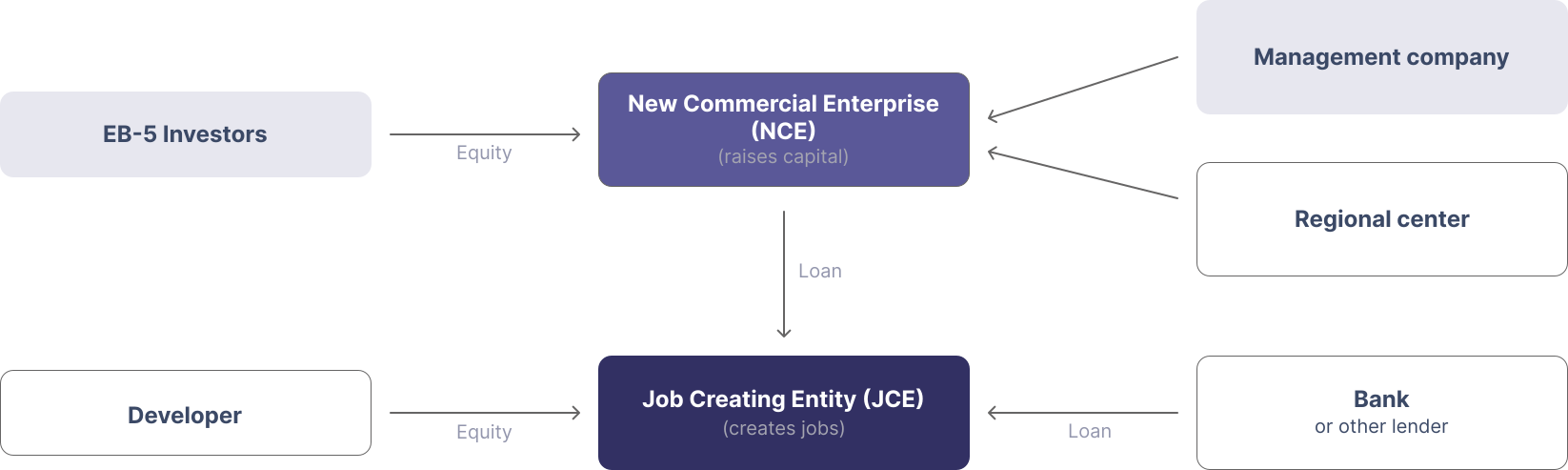
Regional Centers (RCs) are shell companies officially designated by USCIS to raise EB-5 investments within specific states where projects are located. However, in practice, it is the management company that drives the process—it structures the investment project, engages an RC authorized to operate in the relevant state, and oversees capital investment and project execution. The management company creates an EB-5 eligible project structure, invests capital to developer, and acts as the manager of your investment entity (issuer) ensuring that the developer follows construction schedule and complies with the terms of the loan agreement.
There are two types:
01
Rural TEA is any area other than an area within a metropolitan statistical area (MSA) (as designated by the Office of Management and Budget) or within the outer boundary of any city or town having a population of 20,000 or more according to the most recent decennial census of the United States. There are also infrastructure projects – capital investment, outlined in an approved business plan, managed by a government entity that partners with a regional center or new commercial enterprise to use EB-5 funds for public works development.
01
Urban TEA (high unemployment) TEA consists of the census tract or contiguous census tracts in which the new commercial enterprise is principally doing business, which may include any or all directly adjacent census tracts, if the weighted average unemployment for the specified area based on the labor force employment measure for each tract is 150% of the national unemployment average.
EB-5 projects located in rural TEA (plus EB-5 infrastructure projects) grant investors with priority processing of petitions. TEA type will be stated in the project documents. We recommend that you double-check this with the TEA map.
Project documents:
Private Placement Memorandum – discloses all essential information about the project
Subscription Agreement – a contract that allows you to acquire an ownership interest in the new commercial enterprise (NCE) that will invest in the EB-5 project.
Operating Agreement – a legal agreement between the members of your investment entity and the management company, outlining the rights, responsibilities, and governance of the company.
Structure of EB-5 project
This is the company that EB-5 investors invest in. In a typical EB-5 project, each investor acquires one ownership unit in the new commercial enterprise (NCE), usually structured as a limited liability company (LLC). The NCE is managed by a management company, and the invested capital is typically loaned to the job-creating enterprise (JCE).
The company where the jobs will be created. JCE is owned by the project developer. EB-5 investors’ funds are pooled in the NCE and typically provided to the JCE as a loan. Additional project financing is usually contributed by the developer, banks, grants, investment funds, or other capital sources.
This is a project in which NCE provides funds from investors to the project company in the form of a loan. Each project has a fixed coupon rate and a loan term/maturity period. The fixed coupon rate is paid over the life of the loan, beginning on the day the funds are provided to the developer. In a typical EB-5 project, the loan term is 3 to 7 years.
This is a project where NCE invests in a project through preferred shares, pari passu or any other form of equity in JCE. Such projects are inherently riskier but, in theory, have the potential to bring higher returns if business is successful.
In such models, there is no fixed term of repayment of investor’s capital, and it entirely depends on profitable sale or refinancing of the project.
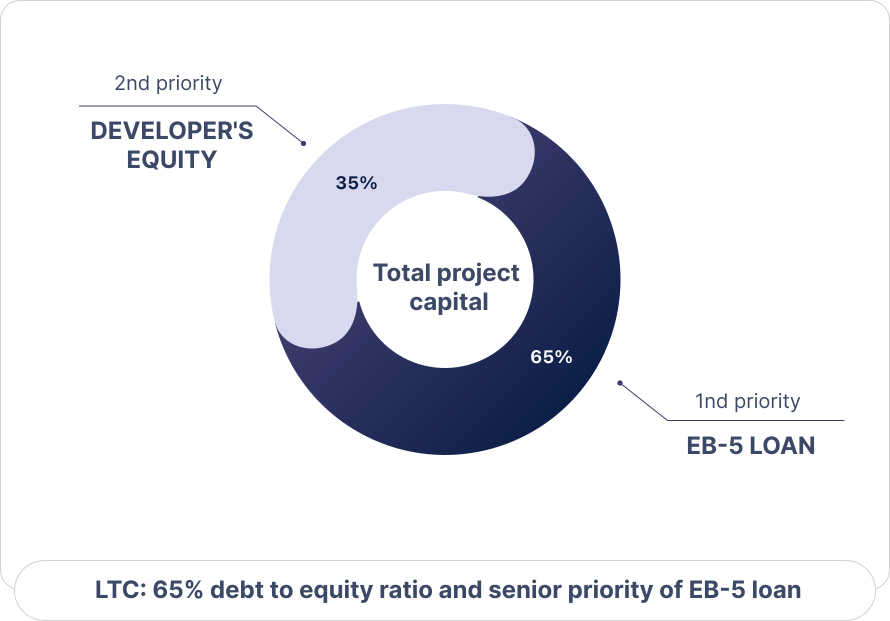
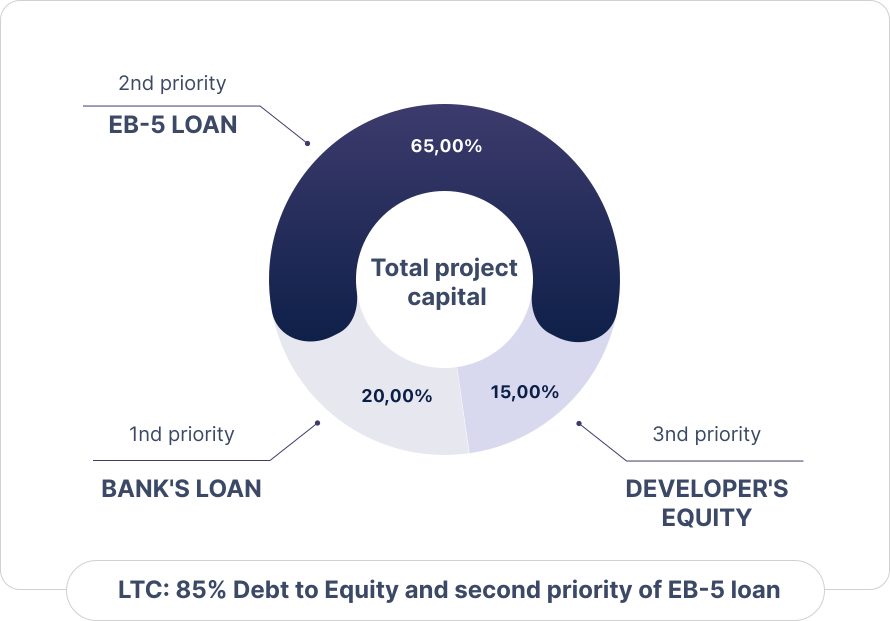
The senior lender has first priority for repayment and the right to foreclose on collateral if the loan defaults. In the event of project failure, the senior lender can take ownership of the unfinished project’s assets and sell them to recover funds. While most often a bank, the senior lender can sometimes be an EB-5 company, and projects with this structure offer the highest level of repayment security.
This lender holds a second lien position, meaning repayment occurs only after the senior lender’s claim is fully satisfied. Most EB-5 investor loans fall into this category, making it essential to understand the senior lender’s rights. The repayment priority directly impacts both the risk and potential return on your investment. Clearly, junior loan pays much higher rate of return than senior.
Other important factors to consider include the asset’s current value during construction, the projected completion date, and the likelihood of the project being finished on schedule.
Schedule a Free Consultation
We will discuss current EB-5 investment projects and select the best solution for your immigration to the USA under the EB-5 visa program.